Author: Máté

  • Control Resonant Review

    Finally hit the credits on my first playthrough in Remedy’s latest piece, released on September 24th. While not being a 100% completionist, it took me exactly 50 hours to get there. There are still some side-quest and collectibles to find, so I will most probably go back for them.

    So, what’s it like?

    More than the sum of its parts

    Resonant is an odd one, even by Remedy’s standards. Compared to other action RPGs on the market (I am thinking of the Horizon series, Final Fantasy 16, God of War and the Witcher 3) it does not do everything 100% well — except maybe for the trademark Remedy weirdness scale where it delivers 11 out of 10 points.

    And yet, it’s part of its charm. The game itself has a unique experimental and explorative nature, which makes it even more lovable. It reminds me of the original Control. It also did not solely do everything gameplay-wise correctly, yet the collectible documents, the lore, the exploration and the general setting made up for it.

    Take for example the combat. Like in Control, this one offers a pretty nice selection of builds for your taste. Yet, just like Control, it also does not go deep enough. You do have some status effects this time (yaay!), but the overall playstyle remains consistent throughout the game. You smash buttons, fill up meters, use unique skills, dodge and run, panic if your health is low and feel satisfied once you have made it out alive. Does this get boring? Not at all. Is it repetitive? Absolutely. Does it make the game replayable? Anytime.

    There is also the pacing. Dylan — much like the Federal Bureau of Control, the FBC itself — is running around in each zone trying to do their best to save people. Most of the time, he is in a reactive role, instead of a proactive one, which is also required by the linear story. And yet, running after some random colleagues, going after distress signals or exploring for exploration’s sake gets boring at times. I also do have to admit, that several zones made me “wow” (the Underpass), “oh my god, this is serious” (Evacuation Zone) or “the situation looks terrible” (the Park). When it comes to the personal stories tied to each of the zones, they are all throwing creative ideas around which is a great addition. There is always something, but also noting. I often had a feeling that the game was continuously extended to fit some ideas, all of which are quite good on its own, but failing as a consistent set. However, this is also a strength of this game.

    The Altered Apocalypse

    Running around and exploring Altered Manhattan never got old. On their journey, players encounter civilians, weird but lovable colleagues both old and new, all trying to hang onto something. The sound design and the music is perfect. It’s melancholic, otherworldly, sympathising. Talking to the Board, executing enemies, the musical sequences and the boss battle themes are all satisfying, brilliant and suiting. Resonant is a pleasure to listen to.

    Except maybe for its characters. The dialogues, like the game itself, feel often “glued together”. It’s lacking some personality, some force, some momentum. Personally, I did not like the voice acting at all. Alan Wake 2 did that much better. Also, the facial animations and the modelling are uncanny. Alan Wake 2 did that much better as well. However, everyone is burnt-out at the same time so it makes sense not everyone is in top shape.

    The setting is beautiful. From the tiny confined spaces to the huge open explorable city, it was a pleasure to take in the view. Not to mention the gravitational shift and grappling hook mechanic. The level design and the visual language both are a masterclass. Resonant does not give you obvious cues where you have to go. Instead, it gives you signs, plays with light and with the sound. Rarely did I feel so happy to get lost. Also figuring out how to break barriers was a fun experience. There are also a bunch of dad jokes scattered around. The setting is the most lovable since Quantum Break.

    Extending the Remedy Connected Universe

    Resonant’s place in the RCU feels a bit off. I wonder if I missed the Alan Wake tie-ins, because I did not complete all side-quests. I expected to see the return of Caldera Street Station, Parliament Tower and the Oceanview Motel. There was nothing. I also firmly believed Ahti, Saga Anderson, The Old Gods of Asgard and even Warlin Door or the Cult of the Word would make a reapparence as a driving force. Nothing. The absence of these fan favourites is disappointing. I really hope we would get two DLCs tying up these lose ends.

    The narrative of the original Control does get extended though. In a pretty organic way even. It surpassed my expectations, deepened the lore, put events into a different perspective. Now we not only have parautilitarians but also Persons of Power. The Entities behind the otherworldly forces all have a reason to behave as they do. At one point, it is even said Manhattan just happens to be in the wrong place at the wrong time.

    The lack of these references makes Resonant a standalone experience for newcomers. Yet, the inclusion of these would not have changed anything. I am thinking about references like the coffee thermos in the Panopticon in the orignal; or Darling appearing in Alan Wake 2; or the aforementioned Oceanview Motel. We do get some hilarious Altered Items, paranatural criminal activity and a lot of unexpected return of “entities” from the original. These are very welcome and made me smile the whole time.

    The “human mind as a metaphysical place” reappears again and becomes a core narrative driving component in the last third of the game. In the finale, the concept becomes increasingly satisfying and through the tie-ins with the Original, it made me melancholic by the time I reached the end credits. Remedy is really good at presenting the surreal, the subjective and the psychological as real, objective and measurable. This time, the conclusion makes the game earn the Control title again.

    Summary

    Remedy is a brand. Their games will never be able to please the mainstream and this is probably for the best. They are the leaders in presenting the surreal. At the same time I do firmly believe they should dare more. There is no shame in copying well-working mechanics from other titles if it suits the gameplay. Resonant feels oftentimes unnecessarily experimental, as if the studio got lost in their attempt to be unique.

    But these are the reasons why I would suggest anyone try all of their games since Quantum Break. Remedy games have a personality and as such, they can be both annoying and lovable at the same time. And I also have to admit: no other title could ever give me the superhero feeling as Remedy games.

    Resonant is simply an 11/10 on the Remedy scale.
  • On the future of the Internet

    This one is going to be a highly speculative post. For this reason, it’s going to be highly opinionated as well.

    I believe the internet as it stands today is going to be restricted in the middle-long term future (15-50 years). And this is going to be a good thing.

    In its original form, the global nature of the World Wide Web gave us almost limitless freedom to share, to communicate (especially anonymously) and to organise. In a way, it can be seen as an indispensable tool in a globalised world. Politics can change, as it is changing now, but the global internet remains rock solid in its freedom.

    Yet, with globality comes the issue of responsibility. If somebody/an entity in a given country does something on the global internet, who is going to make that person/entity responsible for their actions? There is no “internet police”. There is no “internet secret agency”. And just because we consider something illegal in our country, it does not imply we can enforce our laws on another country. That’s not how the global order works.

    It is easy for states to oversee “classical media” (print or television for example). You follow up the line where the stuff is coming from and you identify those responsible, thereby enforcing our expected social standards. In an opaque hierarchical structure, this task is already more difficult. Add to the mix protected anonymity and jumbled up communication lines and it becomes even almost impossible. “Somebody, somewhere did something, which hurt us” is a tough trace to investigate. It sounds bad enough, if a society was organised like that — and yet, we allow these things to happen in cyber space.

    Allow me a small intermezzo: cyber space; call rooms; online conference; electronic mail. The list of “internetised” equivalents goes on. On a linguistic level we already treat the internet as a “social space”.

    Now, our “everyday” “social space” is heavily regulated. The electricity I have in my apartment is standardised; there are rules for the traffic on the street; there are restrictions on what I can express and how I can do that; etc. We did that because it gave us two things: order and stability. Provided, if executed properly — it is a common assumption European societies are sometimes over-regulated in some aspects.

    My pointe is: the time will come when the global internet will be governed by national entities, hence ceasing to become “truly” global. That will have a great benefit: people behind services and simple websites will become more accountable for their actions. I believe free societies will still have access to more content than those living in autocratic or totalitarian regimes. Yet, there will be (strict) limitations on what can be done and accessed.

    There are some political tendencies which (r)enforce my suspicion. Take social media regulations restricting access of adolescent users. There was also GDPR in Europe telling entities how to deal with its citizen’s data. Totalitarian countries (like China, Russia and Iran for example) have already taken extreme measures of what can be accessed from the inside. Several states in the US have passed bills enforcing a built-in age verification system on closed source systems. Hate speech on social media is illegal in Germany. The way online stores are allowed to operate in the EU and what services they can offer and where is also regulated.

    The above examples seem pretty obvious to some. Let me speculate about the future now.

    I believe most countries will find a way to block access to some websites entirely easily, especially for political reasons. Other reasons can be multiple ranging from adult content, distribution of illegal content, hate speech or even fake news. I also believe “free countries” will also make use of this power. In case of a well-working democracy, the people will also hold their government accountable for their actions.

    My second speculation: the days of globalised IT (especially American) firms are numbered. Today in technology, the issue of monopolies is huge. We cannot simply decouple ourselves from the way some big firms dictate how we should do our everyday business. I believe this will change, once countries will develop a firmer grasp on the internet. There is no a priori reason why some software components of these companies’ products should not be open-sourced after some time. At least the technology our digital infrastructure is based on should be accessible and auditable by independent parties. Trust can only be achieved via transparency; open societies can only trust tech, if they can study it, understand it and publish where it fails freely.

    My third speculation: public services will be more and more digitalised. Overall, this will also result in a less anynomised internet, enforcing accountability where needed. I envision a system, where service providers query some data from a public server to allow, restrict or deny access on services. To make this more concrete, here is a hypothetical situation. Let’s say I wish to order alcohol online. For this, I might need to create an account and enter my highly personal credentials (something akin to a credit card number with a password) provided by my local government during check-out. Before accepting my order, the online shop will ask a secure public server, whether I am old enough to buy alcohol. The public server can return “yes” or “no” — there is no need to let the online shop know my exact age. The verification phase will be executed on a secure platform, akin to our credit card purchases online. Now comes the twist: what you have just read, is the 1:1 digitalised version of how we buy our groceries today. I can only buy alcohol if I have my ID with me.

    Regulation enforces accountability, gives us security and can give advantage to the disadvanteged. The cost is our individual freedom and our conform. I do believe this is a price worth to pay in balanced societies.

    So why treat the internet otherwise? Historical reasons will not cut it.

  • My Mom vibecoded an App

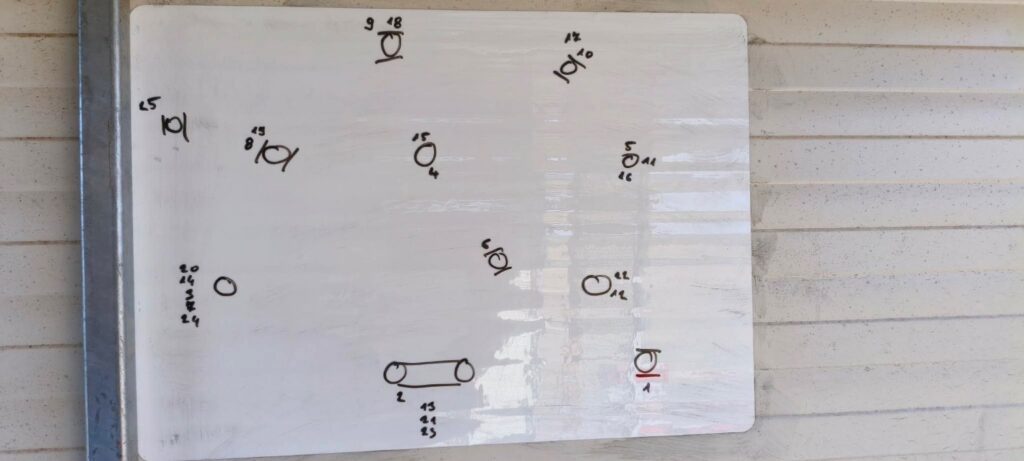
    One day, my mother reached out to me. With her dwarf poodle, she is competing in hoopers — a kind of obstacle course for dogs. She was facing a human issue though: for every map, she had to memorise the layout and she’s reached a point, where the dog was faster than her thinking.

    Initially, she asked ChatGPT if it was possible to use Google Maps to project each of the obstacles to a view. ChatGPT was obviously saying “yes” and offered her to help. Fortunately, she asked me first if it was feasible before going down the rabbit hole herself.

    A hoopers map consists of ~24 obstacles which have to be completed by the dog. My mom has also sent a sketch of the track. The challenge was to project this into some 3D space.

    I asked Claude the same and gave it a description of the obstacles and where the person would be standing. I also told it should preferably create a navigable version.

    What I was not expecting though is what Claude created:

    It took it some 8-10 minutes but it cooked up a complete standalone HTML version with a minimap and a small sized dog. Some impressive work!

    I have lost my mind when I realised there is a dog cam and it has also respected the obstacle numbering. All of that in a single HTML file and JS.

    After I have told my mom about the solution I have found, she wanted to hear all of it. Now she is continuously improving it. Some prompts later she wanted to show her progress. To my surprise, Claude turned the html file into some sort of typescript project and produced several files.

    I then remembered electron exists and figured out a way to turn these simple web-based apps into locally executable .exe. I originally asked Claude to do that, but it had no access to web devtools.

    Now the workflow is this: my mom designs the app, gives me the icon (generated by OpenAI) and the zip it downloads from the chat and I turn it with a press of a button into a executable.

    Never thought I was working with her this way.

    This is, what accessible programming looks like to me. Also, this is one of the most fun applications of AI I have never thought of.